TABLE OF CONTENTS
- How traditional phone systems work
- How VoIP works
- Cost comparison
- Reliability and uptime considerations
- Features side by side
- Scalability as your business grows
- Which one fits your business
- Frequently Asked Questions
TL;DR — IN SHORT
- Traditional phone systems run on dedicated copper lines; VoIP runs on your internet connection.
- VoIP typically costs less per line and bundles features that require add-on hardware with a traditional system.
- Reliability depends on your internet connection — a backup connection closes the main gap versus landlines.
- VoIP scales by adding software licenses, not physical wiring, making it far easier to grow or add remote staff.
- The right choice depends on your internet infrastructure, growth plans, and how many locations or remote workers you support.
VoIP vs. traditional phone systems is a decision most businesses eventually face, whether they’re setting up a new office, replacing aging equipment, or simply trying to cut a phone bill that keeps climbing every year. The two options work on fundamentally different technology, and that difference shows up directly in cost, flexibility, and what happens when something goes wrong.
This guide breaks down how each system actually works, where the real cost differences show up, and which factors should drive your decision — not just the sales pitch from whichever provider you talk to first.
How traditional phone systems work
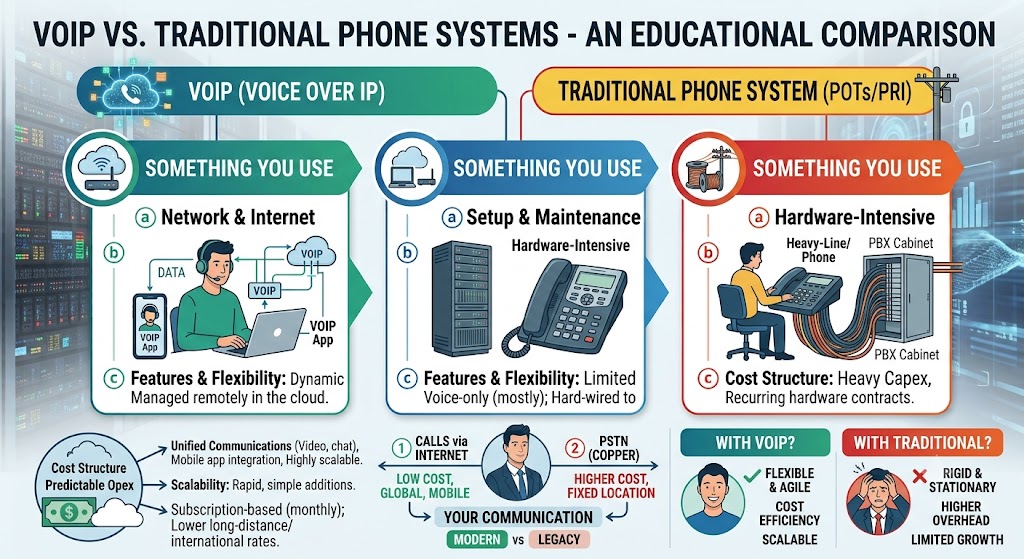
A traditional phone system, often referred to as a landline or PSTN (Public Switched Telephone Network) line, relies on dedicated copper wiring to carry voice signals. Each phone line is a physical connection, which is why adding lines historically meant a technician running new wiring and installing physical hardware.
Because the signal travels over copper lines independent of your internet connection, traditional phone systems have historically been seen as more resilient during internet outages — the phone would still work even if the office Wi-Fi went down.
How VoIP works
VoIP (Voice over Internet Protocol) converts voice into digital data packets and sends them over your internet connection, the same way email or a video call travels. Instead of dedicated copper lines, VoIP uses your existing network — desk phones, softphone apps on a computer, or mobile apps can all connect to the same business phone number.
This is the core distinction driving nearly every other difference between the two systems: VoIP piggybacks on infrastructure you likely already have, while traditional systems require dedicated infrastructure built specifically for phone service.
Cost comparison
Cost is usually the first question business owners ask, and it’s also where the differences are most pronounced.
| Cost factor | Traditional Phone System vs. VoIP |
| Line installation | Traditional: requires physical wiring per line. VoIP: no new wiring — lines are software-based extensions. |
| Monthly line charges | Traditional: typically charged per physical line. VoIP: usually bundled per user, often with lower per-line costs. |
| Long-distance and international calls | Traditional: often billed separately at higher per-minute rates. VoIP: frequently included or billed at significantly lower rates. |
| Hardware | Traditional: requires a dedicated phone system (PBX) on-site. VoIP: often cloud-hosted, reducing on-site hardware and maintenance. |
| Adding new users | Traditional: requires new lines and wiring. VoIP: typically a matter of adding a software license. |
📌 Note: Sticker price on a VoIP plan isn’t the whole picture. Factor in your current internet bandwidth — if your connection isn’t sized for the additional voice traffic, you may need an upgrade before switching, which changes the total cost equation.
Reliability and uptime considerations
The reliability argument used to favor traditional lines clearly, since a landline doesn’t depend on your office internet connection. That gap has narrowed significantly as internet infrastructure has become more dependable, but it hasn’t disappeared entirely.
- Internet outages — a VoIP system goes down if your internet connection goes down, unless you have a backup connection or failover plan in place.
- Power outages — both systems can be affected, though traditional analog lines sometimes stay powered through the phone network itself, while VoIP requires networking equipment to have power (often addressed with a UPS battery backup).
- Call quality — VoIP call quality is directly tied to your internet bandwidth and network configuration; a poorly configured network can lead to dropped calls or audio lag that a traditional line wouldn’t experience.
For most businesses today, a properly configured VoIP system with a secondary internet connection or mobile failover closes this reliability gap almost entirely — but it does require planning it out, rather than assuming it will just work.
Features side by side
This is where VoIP tends to pull ahead clearly, since many features that require costly add-on hardware on a traditional system are built into VoIP platforms by default.
- Auto-attendants and call routing — standard on most VoIP platforms; often an added cost on traditional systems.
- Voicemail-to-email — common on VoIP; rarely available natively on traditional lines.
- Mobile and desktop apps — VoIP numbers work from a laptop or phone app anywhere with internet; traditional lines are tied to the physical handset.
- Video conferencing integration — many VoIP providers bundle video calling directly into the same platform.
- Call analytics and reporting — VoIP platforms typically offer detailed call logs and reporting dashboards out of the box.
Scalability as your business grows
Growth is often the deciding factor for businesses that outgrow a traditional system. Adding a new employee to a traditional phone system may mean scheduling a technician visit to run a new line. On a VoIP system, adding a user is typically a matter of assigning a new license and shipping (or configuring) a device — no physical wiring required.
This becomes especially relevant for businesses with multiple locations or a growing remote workforce, since VoIP extensions work identically whether an employee is in the main office, a satellite location, or working from home.
Which one fits your business
There’s no universal right answer — the decision depends on a handful of practical factors specific to your business.
- Internet reliability at your location — if your connection is inconsistent, address that first, or plan for a backup connection before switching to VoIP.
- Growth plans — businesses expecting to add staff, locations, or remote workers benefit disproportionately from VoIP’s flexibility.
- Existing hardware investment — if you recently invested heavily in a traditional PBX system, the calculation may look different than for a business starting fresh.
- Feature requirements — if your team relies on mobile access, video integration, or detailed call analytics, VoIP will likely deliver more value out of the box.
Conclusion
For most growing businesses, VoIP offers a stronger combination of cost, features, and flexibility than a traditional phone system — provided the internet infrastructure is properly assessed and configured to support it. The technology decision is only half the equation; getting the network, bandwidth, and failover planning right is what actually determines whether the switch feels seamless or frustrating.
If you’re weighing VoIP installation and support for your business, our team can assess your current network and recommend a setup that fits your size, growth plans, and budget.
FREQUENTLY ASKED QUESTIONS
| Question | Answer |
| Is VoIP reliable enough to replace a traditional phone line? | Yes, for most businesses, provided the internet connection is stable and properly configured with sufficient bandwidth and, ideally, a backup connection for continuity during outages. |
| Does VoIP work during an internet or power outage? | Not without a backup plan. Because VoIP depends on internet connectivity, most providers recommend a secondary internet connection or automatic call forwarding to mobile devices during outages. |
| Can VoIP support remote and hybrid teams? | Yes, VoIP numbers and extensions can be used from any location with an internet connection, through desk phones, softphone apps, or mobile apps, making it well suited for remote and hybrid work. |
| Is switching from a traditional phone system to VoIP expensive? | Migration costs vary by business size and existing infrastructure, but most businesses see lower ongoing costs over time due to reduced line charges and consolidated billing. |
Author
-
At Computer Services New Jersey, led by George Ancuta, we believe that small and midsize businesses deserve the same level of security, reliability, and strategic foresight as global financial institutions. Our firm provides more than just support; we offer a quarter-century of technical perspective forged in the world’s most demanding financial and corporate environments.